Specialist AI agents that run construction operations — live in production today, moving real iron. This page is the honest breakdown of what’s shipped: what each piece does, who uses it, and what it saves. Dispatch is first; the suite grows from here.
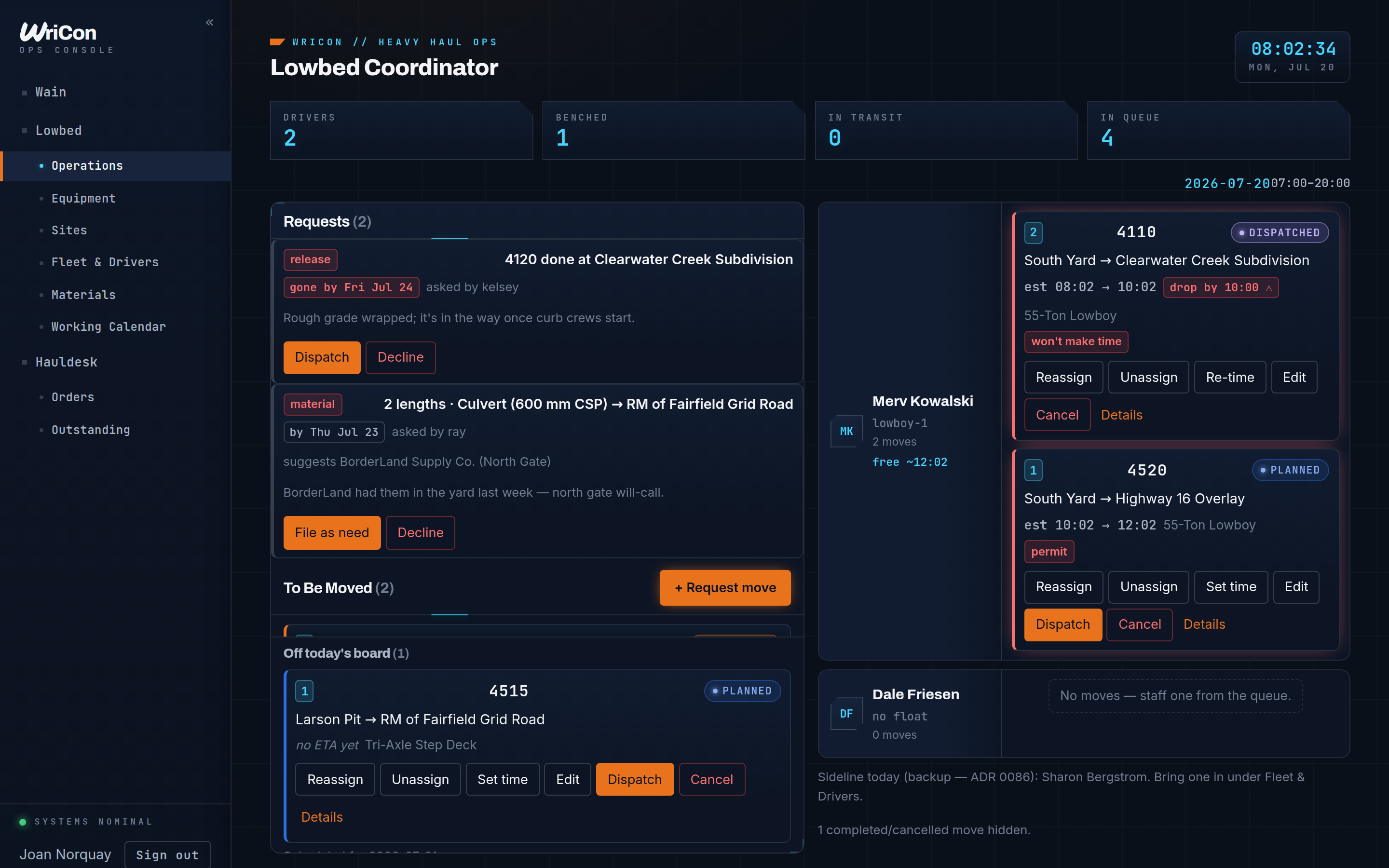
Wain keeps the whole lowbed day in one queue — moves, conflicts, drivers, and the field's asks — and catches problems while they're still cheap.
The dispatch module is where the suite started, because it’s where the money leaks: a lowbed day is a chain of small commitments — this machine, that trailer, this driver, that window — and one broken link ripples through all of them. Wain holds the whole chain, checks every change against it, and keeps the plan honest as the day moves.
One person can run a fleet's worth of moves without the whiteboard, the sticky notes, or the 6 a.m. phone tree — and the expensive misses (a permit gap found at the scale, a machine promised to two jobs) get flagged the evening before instead.
The Cat 336 has to get from the yard to the Highway 16 overlay, and it's oversize — Wain flags the missing permit before the truck is loaded. The D6 was promised to the subdivision by 10:00, but the queue says its driver can't make that drop — flagged, moved, solved at 6:40 a.m. Meanwhile the grading foreman's packer request from last night is already sitting in the queue with a want-by date attached.
Plain language in, dispatcher-grade answers out — typed or spoken, on whatever device is in reach.
Every agent in the suite is reachable the same way: a conversation. The door is a chat that behaves like your best dispatcher on their best day — it already knows the context, it proposes rather than assumes, and when something needs your sign-off it puts a card in front of you instead of a wall of text.
Nobody learns new software. The training course is one sentence — "just tell it what you need" — which is why it actually gets used from day one, in the office and from the cab.
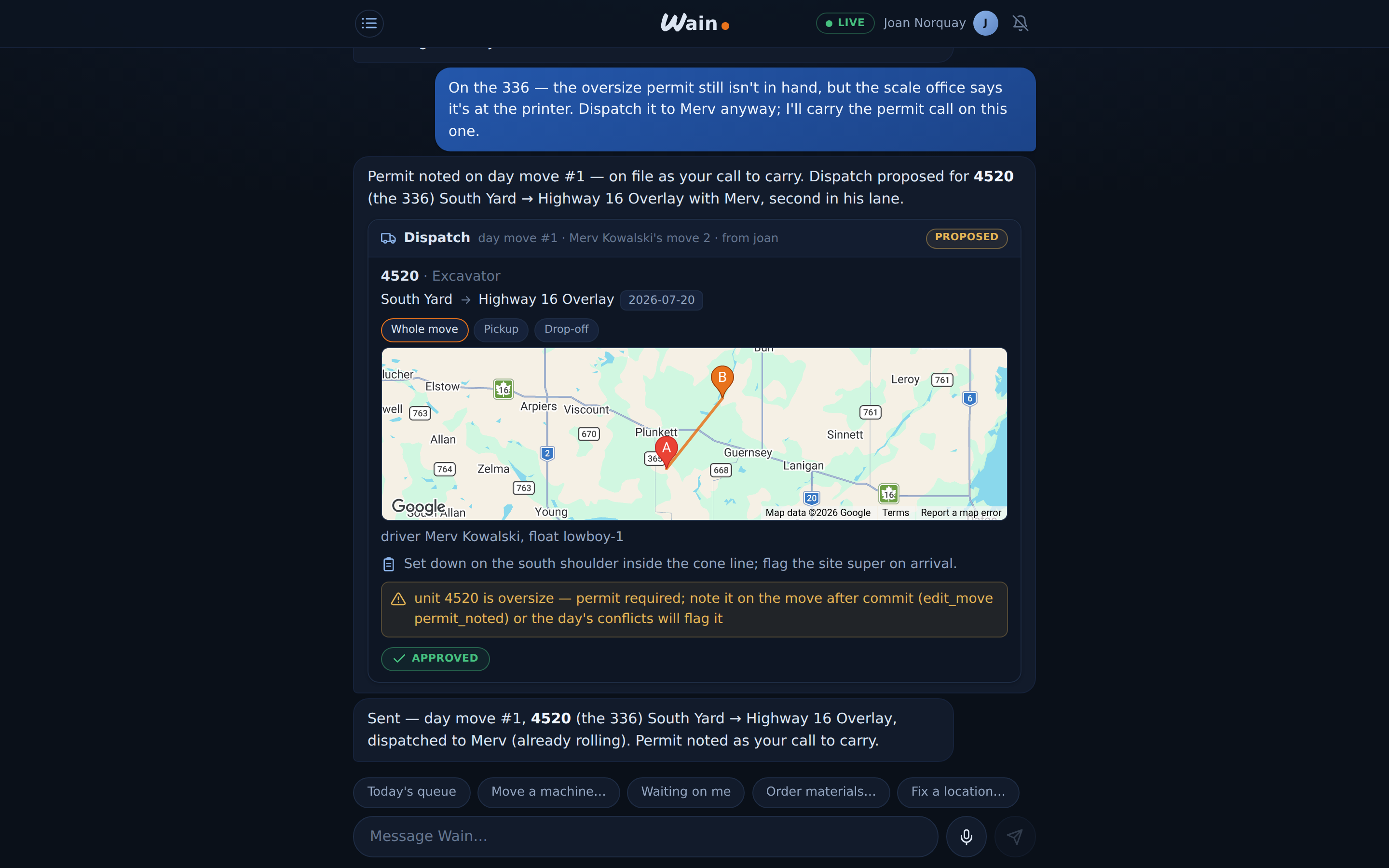
One sentence from the dispatcher. Wain answers with a move card: unit 4520 from the South Yard to the Highway 16 overlay, lowboy and driver suggested from the standing rotation, permit flag raised because the 336 runs oversize. One tap to confirm — the move is queued, the driver gets briefed, and the site contact is on the card.
A live dashboard shaped to each role — the dispatcher's board, the admin's controls, and the audit trail, all in one place.
The dashboard is the suite’s shared surface: the same live state the agents work from, rendered for humans. It’s deliberately field-grade — high contrast, fast, readable on a phone in sunlight — because that’s where operations actually look at it.
The answer to "where are we at?" becomes a glance instead of three phone calls — and when something looks wrong, the audit trail answers "who changed this and when" in seconds instead of an argument.
Six moves on the board: two complete, one in transit, one flagged — the D6's drop time won't be made — and two waiting on confirmation. The open-requests rail shows the packer ask for Highway 16 and a culvert order for the grid-road job. The superintendent reads the whole morning in under a minute, from the truck.
The agents, the board, and the day's briefs on the phones the crew already carries — installable from the browser today, with native iOS and Android apps on the way to the stores.
The suite meets the field where it lives: the phone. Today that’s an installed web app with push; the native iOS and Android apps — same instance, same agents, same live state — are in the store pipeline. Either way, the loop between office and field closes without anyone chasing anyone.
The gap between "dispatch decided" and "the field knows" drops to zero. No printed run sheets, no morning phone tree, no "nobody told me" — the brief is on the phone before the coffee's poured.
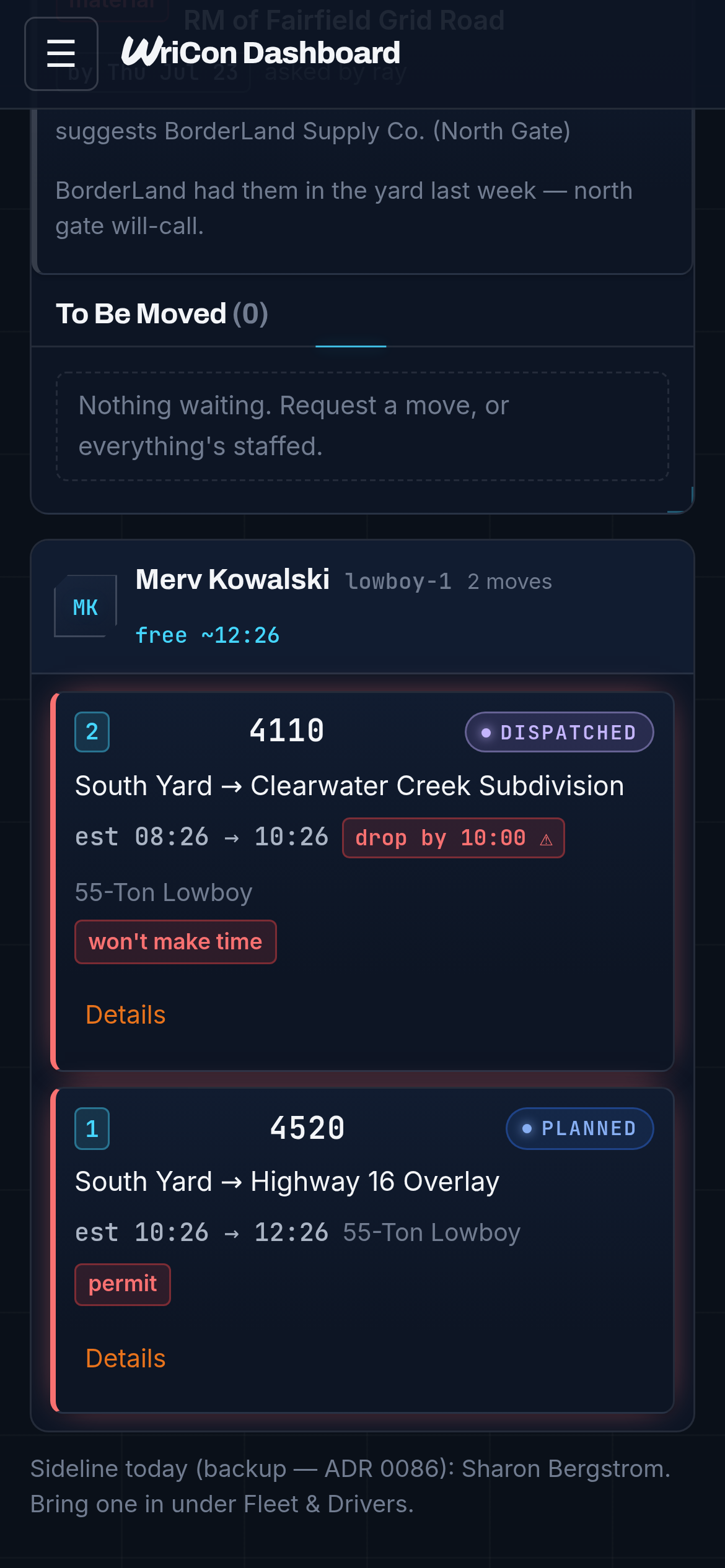
Merv opens the app at 6:15: two moves today. First card — the 336 to the Highway 16 overlay, pin at the west tie-in, "flag the site super on arrival." He taps rolling when he's loaded, dropped when it's off the trailer, and the board updates itself. The only radio call is the one he didn't have to make.
Feed the instance your specs, contracts, and drawings — then ask questions and get answers grounded in your actual documents.
Construction runs on documents nobody has time to read twice. The document module gives each instance a working memory of its own paper, so the answer to a spec question is a lookup, not an archaeology project.
The twenty minutes spent hunting a clause becomes a ten-second question — and the answer comes with the section it came from, so you can trust it enough to act on it.
Asked in chat, answered from the project's own spec book: the required density, the lift thickness, and the section reference — pulled from the documents Tamarack loaded, not from the model's imagination. The PM reads the cited clause without leaving the conversation.
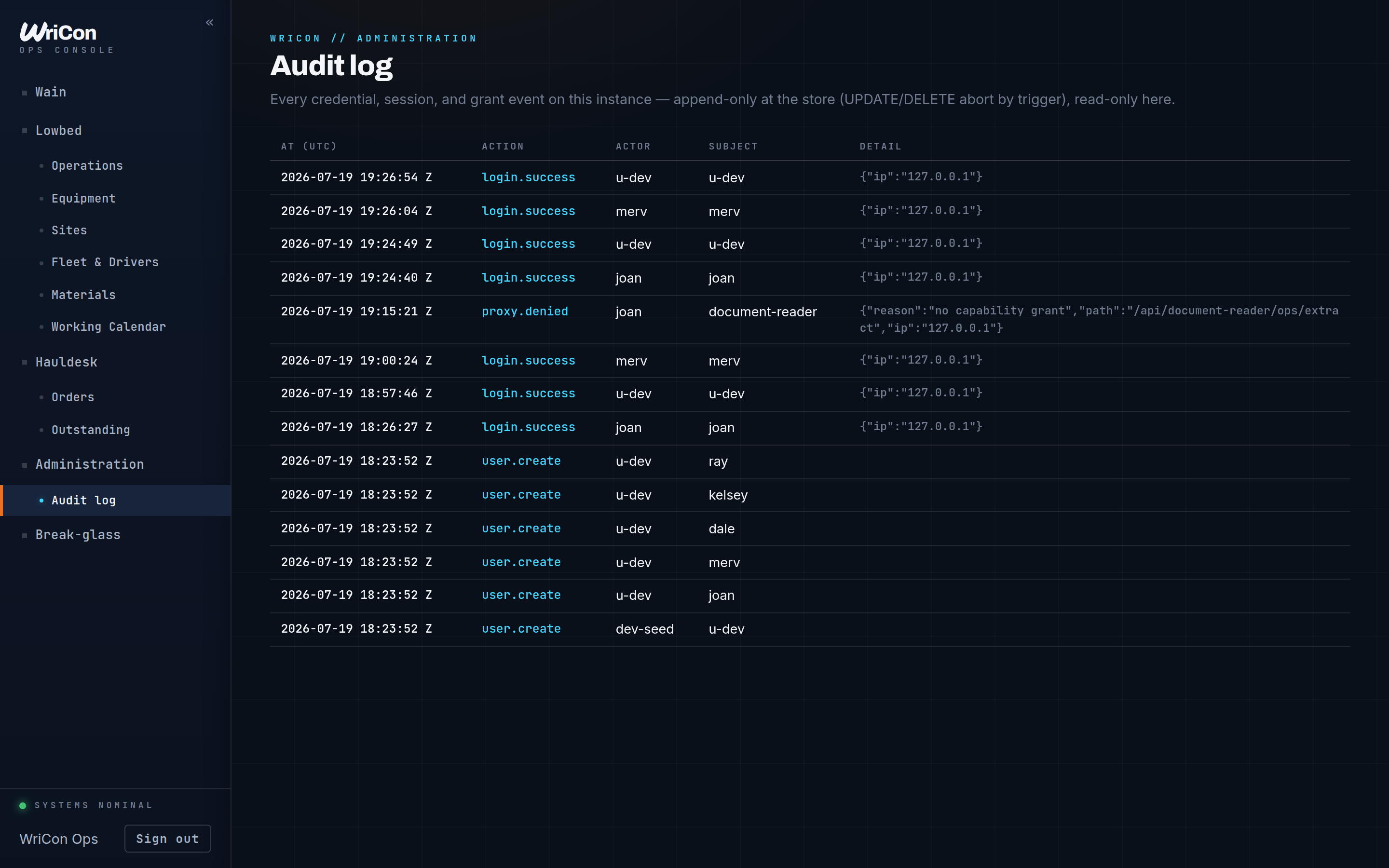
The suite is built human-in-the-loop from the ground up: role-based authority, confirm-by-default writes, and an audit trail on everything.
AI in operations only works if you can trust it on a bad day. The suite’s answer is structural: agents never act alone on anything irreversible, authority follows roles, and the audit trail is a first-class surface — not a log file someone has to go digging for.
You get the speed of automation without handing it the keys. When something needs explaining — to a client, an insurer, or yourself — the trail is already written.
The dispatcher pushes a move through even though Wain flagged the timed drop as tight — their call, and the audit viewer shows exactly that: the agent's flag, the human's confirmation, the timestamp. Three weeks later, when someone asks why the drop ran late, the answer takes thirty seconds and settles the question.
All worked examples and screenshots on this page use synthetic data from Tamarack Ridge Contracting Ltd. — a fictional demo company. No client data appears on this site, ever.
Start with a call — one conversation, no prepared sales deck. We’ll show you the agents working a real dispatch day, talk through what your operation looks like, and tell you honestly whether this fits it.